Ranging Accuracy and Precision
1 Overview
Lidar determines the distance to a target object by actively emitting laser beams and measuring the time-of-flight (ToF) of the reflected light. In practical applications, we not only need to know how close the measurement results are to the true distance but also need to understand the stability and consistency of the measurement results. Accuracy and precision are the key parameters used to describe these two aspects.
2 Definitions
2.1 Accuracy
Accuracy refers to the degree of deviation between the measurement results and the ground truth value. In lidar distance measurement, accuracy reflects the deviation between the average distance value obtained from multiple measurements of a target under certain conditions and the ground truth distance of the target.
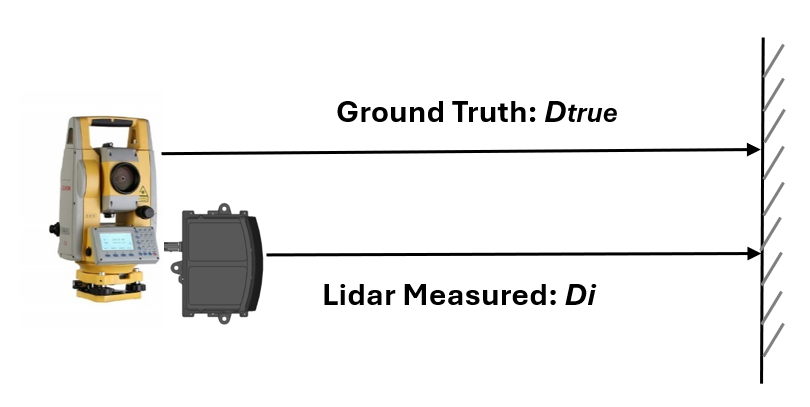
As shown in the figure above, the ranging accuracy of lidar can be evaluated by the deviation 𝜇 between the average value of multiple measurement results and the ground truth distance of the target (this value is usually calibrated using highly accurate distance measurement equipment, such as a total station). The specific formula is as follows:
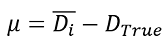
(In this formula, 𝐷𝑖 is the result of a single measurement, and 𝐷𝑇𝑟𝑢𝑒 is the ground truth distance of the target.)
The smaller the 𝜇, the higher ranging accuracy of the lidar. The main factors affecting lidar ranging accuracy include:
- Systematic errors: Calibration of the lidar, environmental factors (e.g., temperature, air pressure), etc.
- Errors inherent in the lidar measurement mechanisms itself.
2.2 Precision
Precision refers to the repeatability or consistency of measurement results, i.e., the degree of dispersion among the results when measuring the same target object multiple times. In lidar distance measurement, precision reflects the stability of the measurement results under the same conditions.
Similarly, referring to the schematic diagram in the above figure, the ranging precision of lidar can be evaluated by calculating the standard deviation 𝜎 of multiple measurement results. The specific formula is as follows:
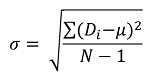
(In this formula, 𝜇 is the deviation of the average distance value from the ground truth distance calculated earlier, and 𝑁 is the total number of measurements.)
The smaller the 𝜎, the higher ranging precision of the lidar. The main factors affecting lidar ranging precision include:
- Measurement noise: Photonic and electronic noise generated by the internal components and circuits of the lidar can affect the stability of the measurement results.
- Signal jitter: Instabilities during the emission and reception of laser pulses can cause signal jitter.
- Surface characteristics of the target object: The reflectivity, surface roughness, and other properties of the target object can affect the intensity and stability of the reflected signal, thereby influencing measurement precision.
3 Relationship Between Accuracy and Precision
Accuracy and precision are two different concepts. Accuracy focuses on the deviation of the measurement results from the ground truth value, while precision focuses on the repeatability or consistency of the measurement results.
To better understand the difference between the two terms, we can refer to the shooting target example illustrated below. Assume a shooter is practicing target shooting, where the bullseye represents the ground truth position of the target (ground truth distance). After multiple shots:
- The bullet hits are concentrated in a region on the target, but this region is overall offset from the bullseye: This is similar to the case where lidar has high precision but low accuracy, i.e., the measurement results are very consistent but deviate significantly from the true value.
- The bullet hits are relatively scattered but all located around the bullseye: This is similar to the case where lidar has low precision but high accuracy, i.e., the measurement results are inconsistent but overall close to the true value.
- The bullet hits are scattered all over the target with no concentrated region: This is similar to the case where lidar has both low precision and low accuracy, i.e., the measurement results deviate significantly from the true value and lack consistency.
- The bullet hits are both concentrated and very close to the bullseye: This is similar to the case where lidar has both high precision and high accuracy.
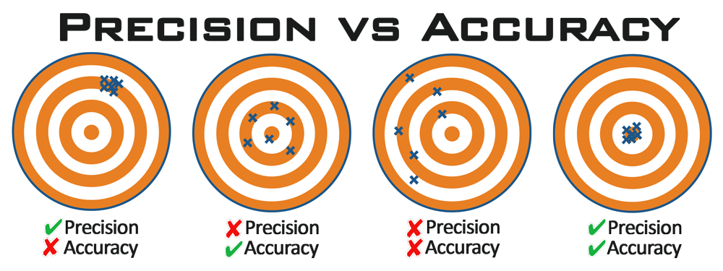
In practical applications, both ranging accuracy and precision are important indicators for evaluating lidar measurement performance. An excellent lidar product should have both high ranging accuracy and high precision, meaning the measurement results are both close to the ground truth value and highly stable. For example, in autonomous driving applications, lidar needs to accurately perceive the distances of objects in the surrounding environment, and the results of each measurement must remain consistent to ensure the safe operation of autonomous vehicles.
Find it useful?